Celebrity-Owned Brands: Why Creators Are Choosing Equity Over Endorsements
The celebrity endorsement is dead, and what has replaced it is more interesting. A generation ago, a brand paid a famous person to hold up the product. Today, celebrity-owned brands and creator-backed brands are rewriting that relationship entirely. The biggest names in consumer are no longer renting their faces to a marketing budget, they are underwriting the companies themselves.
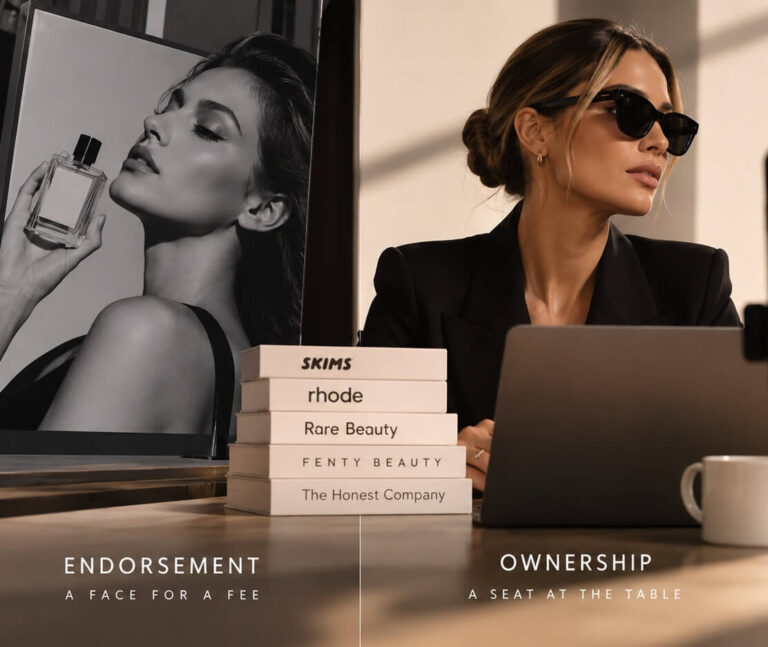
Rihanna built Fenty Beauty into a business now valued in the billions. Jessica Alba built The Honest Company and took it public. Selena Gomez holds the majority of Rare Beauty. Kim Kardashian co-founded SKIMS and compounded it to a $5 billion valuation. These are not spokespeople collecting a fee for an appearance. They are founders with real equity and real authority over the brand, and that distinction is reshaping celebrity brand equity, creator ownership and the executive talent needed to run what these names have built.
From Celebrity Endorsement to Celebrity Ownership
Look one layer down, though, and the model refines further. In nearly every case, the celebrity owns brand and creative, while a professional operator runs the company beside them. Kim Kardashian is Chief Creative Officer of SKIMS; Jens Grede is the CEO who scales it. Hailey Bieber founded Rhode, took the Chief Creative Officer seat, and sold the brand to e.l.f. Beauty for up to $1 billion while retaining control of product and marketing. Bethenny Frankel entered dpHUE as Chief Brand Officer with a genuine ownership stake, having already built and exited Skinnygirl years earlier.
Notice which seats these celebrity founders are actually offered: brand, creative, vision, rarely the CFO’s chair, and rarely the full P&L. That is not a limitation on the celebrity’s role. It is a deliberate division of labor, in which the founder supplies audience and taste and the operator underwrites margin and execution.
The Operator Behind the Celebrity Brand
For founder-led consumer brands, that division of labor makes the choice of professional leadership beside the founder one of the most consequential talent decisions the company will make. The strongest celebrity-owned brands orchestrate both sides on purpose: a founder who can generate demand and define the brand’s point of view, paired with an operator who understands consumer brand equity well enough to build the infrastructure, protect the margin and run the business at scale. Get that pairing wrong, and even a founder with enormous cultural equity can struggle to convert it into a durable company.
The Next Evolution: Creators as Investors
Now watch the next move, because it is already underway. Increasingly, the creator is not taking a title at all, the creator is taking equity, early, across a portfolio of brands, in a shift that is turning creator economy investment into its own asset class.
Alix Earle has assembled a consumer portfolio with four positions across four categories. She took a stake in poppi in 2024, before PepsiCo acquired the brand for $1.95 billion. A strategic investor later took a position in SipMARGS alongside her. She backed GORGIE after its Series A, as the brand’s distribution scaled from under a thousand Target doors toward the mass market. And she holds a position in Cymbiotika, a wellness brand that has tripled sales in two years.
This is not an endorsement deal. It is a cap table. First celebrities became founders; now creators are becoming investors, converting audience directly into ownership without ever holding an operating seat.
The Title Is the Marketing. The Equity Is the Substance.
The endorsement fee was always a cost line on a marketing budget. Creator capital is a position on the cap table, and that distinction is the whole story.
Fame once bought a photo shoot. Now it buys ownership and aligned incentive, and the celebrity founders and creator investors who understood this early did not lend themselves to a brand, they took a piece of it. When the next celebrity title or creator deal is announced, the headline is rarely where the value sits. The ownership structure behind it is.
For consumer leadership teams, this shift raises a talent question as much as a brand question. Every celebrity-owned brand and every creator-backed cap table still needs an operator: someone who can run the P&L, build the organization and translate audience into a scalable business. As celebrity ownership and creator investment become standard features of the consumer landscape, demand for that operator talent, proven executives who can partner with a founder rather than simply manage a marketing budget, is only going to grow.
About The Talent Studios
The Talent Studios is a consumer-focused executive search firm partnering with companies navigating growth, transformation and leadership change. We help consumer organizations identify executives whose capabilities align not simply with the roles companies have held historically, but with the ownership structures, founder partnerships and growth models they are building next.