Five Consumer CEO Moves and What They Signal
Two recent CEO announcements landed on September 30. General Mills named COO Dana McNabb as its next CEO. Mattel named lead independent director Roger Lynch as chairman and CEO. McNabb has spent 27 years at General Mills and now runs operations across the company. Lynch comes from media and technology but has spent eight years inside Mattel’s boardroom. Very different résumés. Very different routes to the same seat.
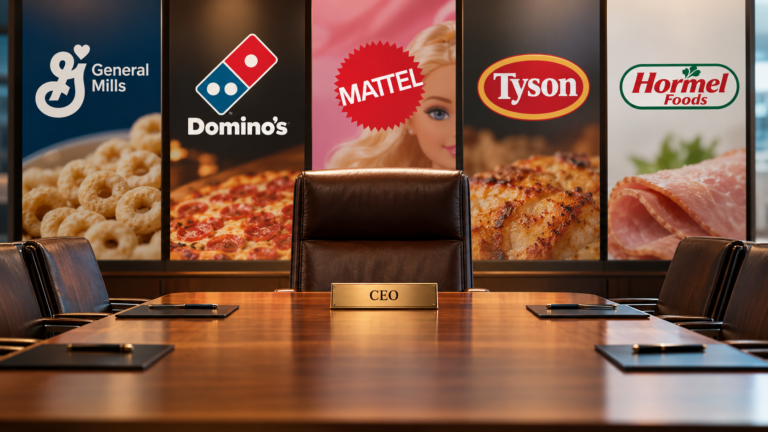
Add recent CEO moves at Domino’s, Tyson Foods and Hormel, and you can see how boards have approached succession from several angles. Two promoted their operators. Two chose people already sitting in the boardroom. One used the president role to give a returning executive time before handing him the CEO job.
What each route tells us about how consumer companies are approaching the CEO decision.
- Hormel: Give the Successor a Runway
John Ghingo becomes CEO of Hormel Foods on October 26.
He’s not a traditional lifer. Ghingo rejoined Hormel in 2024 after more than 15 years at Mondelēz and time leading Applegate Farms. Hormel promoted him to president in July 2025, the same month former CEO Jeff Ettinger returned as interim CEO following Jim Snee’s retirement. Ettinger stays on the board after Ghingo takes over.
We like the structure because Hormel didn’t have to force the decision early. It brought back a CEO who knew the company, put Ghingo in the president seat and gave the board more than a year to watch him operate before completing the handoff.
You don’t always have the luxury of developing a CEO candidate for five years. Sometimes you have someone who looks right but hasn’t been tested broadly enough. The number-two role can give you that test.
And Ghingo brings something a long-tenured internal successor wouldn’t. He knows Hormel, but he also spent years outside it. The board gets some continuity without simply repeating the same leadership experience.
- Tyson Foods: Look at Who Is Already Sitting at the Table
Jeff Schomburger became Tyson Foods CEO on October 4, replacing Donnie King.
Schomburger spent 35 years at Procter & Gamble and retired as its Global Sales Officer in 2019. That’s a long operating career inside one of consumer’s better-known leadership training grounds. But Tyson didn’t pull him from a conventional external CEO search. Schomburger had already served on Tyson’s board since 2016.
That changes the risk profile of the hire.
He comes from outside the Tyson operating organization, but he has spent a decade around the company. He knows the board. He has seen the strategy. He has watched the leadership team. And the board has had years to watch how he thinks.
We tend to divide succession candidates into two buckets: internal and external. Boards should probably use three. Internal candidates, external candidates and people outside the management team whom the company already knows well.
Your board can be part of that third pool.
- Mattel: A Board Member With a Different Playbook
Mattel went down a similar path, but Roger Lynch brings a very different résumé.
Lynch became chairman on October
2 and is set to become CEO no later than November 2. He has served on Mattel’s board since 2018, including as lead independent director, but his operating career sits largely in media and technology. He leads Condé Nast and previously ran Pandora and founded Sling TV.
Ten years ago, that résumé might have looked unusual for the CEO of a toy company. Mattel today gives you a different context. The company has pushed beyond toys into entertainment, intellectual property and broader brand monetization. Lynch hasn’t run Mattel’s operating business, but he hasn’t been watching it from the outside either. Eight years on the board gives him access to the company, its economics and its leadership that an external candidate coming through a search process simply doesn’t have.
Tyson and Mattel made similar structural bets. Both chose sitting directors. But they did it for different reasons. Tyson gets decades of consumer operating experience from P&G. Mattel gets a media and technology executive who already knows the company.
For boards, that’s a useful distinction. Don’t just ask who you know. Ask which people you already know have experience that fits where the company is going.
- Domino’s: Make Succession Boring
Joe Jordan became CEO of Domino’s on October 1 after nearly 15 years with the company.
Before taking the top job, Jordan served as COO and President of Domino’s U.S. and held senior roles across both its U.S. and international businesses. He has already run large pieces of the company. Russell Weiner, meanwhile, hasn’t walked out the door. He became Executive Chairman Designate when Jordan took over and is expected to become Executive Chairman following the company’s 2027 annual shareholder meeting.
Domino’s announced the transition months before it happened. Everyone knew the dates. Everyone knew the successor. And everyone knew what role Weiner would have after Jordan moved into the CEO seat.
That’s about as clean as CEO succession gets.
Boards often spend a lot of time discussing who could become CEO and less time building the jobs that let someone prove they can do it. Domino’s had Jordan in the COO seat, gave him broad operating exposure and then moved him up.
If you can make a CEO transition look boring from the outside, you’ve probably done a fair amount of work before anyone announced it.
- General Mills: The COO as CEO-in-Waiting
General Mills announced September 30 that Dana McNabb will become CEO on January 1, 2027.
McNabb has spent 27 years at General Mills. She became COO in June after leading North America Retail and North America Pet. Jeff Harmening, CEO since 2017, will move into the Executive Chair role. McNabb’s appointment puts another name on a growing list of consumer COOs moving into the top job. Joe Jordan just made the move at Domino’s. Henrique Braun moved from COO to CEO at Coca-Cola earlier this year. Shailesh Jejurikar did the same at P&G.
Four large consumer companies. Four COOs moving into the CEO seat. The COO job gives a board a long look at how someone operates beyond a single function. You can see how they allocate resources, deal with competing priorities, work with the CFO, lead other senior executives and handle the parts of the company that don’t sit neatly inside their original expertise.
What We’d Take From These Five
The five appointments fall into three groups.
General Mills and Domino’s promoted the operator. Mattel and Tyson went to people already sitting on the board. Hormel created a longer runway for someone it knew but still wanted to test. None of those approaches requires a company to know exactly who its next CEO will be years in advance. They do require you to build credible options before you need them.
For a board, we’d start with the COO. Is this person getting enough exposure to become a legitimate CEO candidate? If not, is that because they need development, or because you’ve hired the wrong profile for succession?
Then look at the board. Tyson and Mattel show why sitting directors shouldn’t automatically sit outside the succession conversation. A director with the right operating background can give you outside experience without starting from zero on company knowledge.
And then look at the transition itself. Harmening moves to Executive Chair at General Mills. Weiner stays as Executive Chairman at Domino’s. Ettinger remains a Hormel director. King stays on Tyson’s board.
Keeping the predecessor close can help. But only if everyone knows who has the job. we’d define the former CEO’s scope, decision rights and exit timing before the new CEO starts. Otherwise you can give a new CEO the title without giving them the room to lead.
The five appointments also change how I’d build a CEO succession slate.
Don’t give the board five versions of the same candidate. Give them the best internal operator. Look at directors or other executives who already know the company. Then compare both against external executives who have already solved the problem the company expects its next CEO to solve.
That’s a much better succession conversation than starting a search when the CEO tells you they’re leaving.
About The Talent Studios
The Talent Studios is a consumer-focused executive search firm partnering with companies navigating growth, transformation and leadership change. We help consumer organizations identify executives whose capabilities align not simply with the roles companies have held historically, but with the business models, growth channels and organizational structures they are building next.