Perspectives from the Franchise Field
Every year around this time, we spend some time dissecting the Franchise Times Top 400. It isn’t a perfect proxy for the industry, but it’s a useful read on how established systems and emerging concepts are performing, and where operators and investors are placing their bets. The 2026 list, just released and covering FY’25 performance, shows systemwide sales across the ranked brands up 4.3% to $784.6 billion. Underneath that healthy headline, the picture is more uneven.
Traditional dining staples were soft: pizza grew 1.6%, sandwich 0.8%, casual dining was flat and breakfast declined 1.4%. Even so, restaurant franchisors have drawn a steady stream of sponsor capital, with buyers drawn to their asset-light structure, brand equity, and defined value prop as defensive investments. In 2024-25, Blackstone made banner acquisitions of Tropical Smoothie Café (No. 60) and Jersey Mike’s (No. 27), taking the latter public only 18 months later. Roark put up substantial capital for No. 10 Subway (2023) and No. 82 Dave’s Hot Chicken (2025). In 2025, headline deals included Rhone Group’s acquisition of Freddy’s Frozen Custard & Steakburgers (No. 79) and RaceTrac’s take-private of Potbelly, a strategic acquisition intended to shore up its foodservice capabilities.
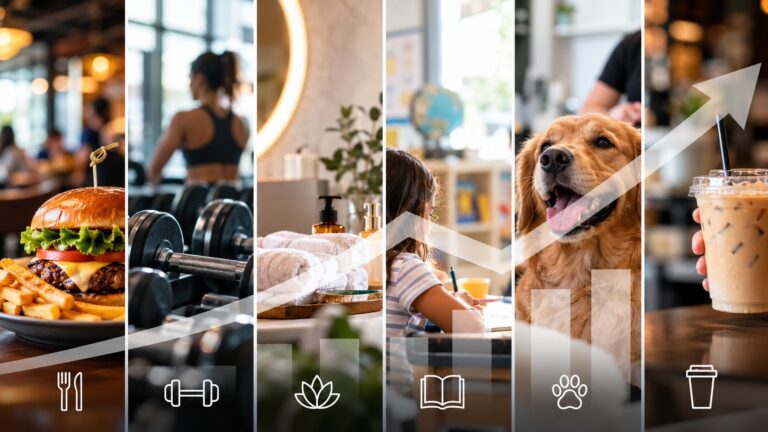
Beyond those headline deals, three business profiles stood out for their growth in 2025: services with recurring customer relationships, essential services, and everyday indulgence.
1. Franchise services with recurring customer relationships.
· Fitness grew 10.6% across formats. Memberships provide revenue visibility, while consumers; continued prioritization of health and wellness supports demand. Private equity capital is prevalent across the list, with two founder-led outliers, Burn Boot Camp (No. 209) and barre3 (No. 383). Crunch Fitness (No. 62) led big-box growth, comping up 27.6% following its acquisition by Leonard Green & Partners in early ‘25. Club Pilates (No. 74) crossed $1 billion in sales, up 23.4% and well ahead of its Xponential sister brands Pure Barre (No. 222) and StretchLab (No. 216). Within Roark-backed Purpose Brands, Anytime Fitness (No. 42, up 12.5%) and The Bar Method (No. 487, up 10%) offset the struggling Orangetheory Fitness (No. 77, -8.3%).
· Personal care saw strong results as consumers increasingly make room for beauty and wellness routines, often locked in by memberships or regular appointments. Newcomer VIO Med Spa (No. 373), backed by Freeman Spogli & Co. since 2024, led the category with 41.3% comp sales, followed by The NOW Massage (No. 317) at 40%. Within TSG-backed Radiance Holdings, Sola Salon Studios (No. 187) and Woodhouse Day Spa (No. 225) ticked up 5.1% and 15% respectively. Sola is one of several salon-suite concepts on the list, where the recurring relationship and revenue is tied to a professional’s suite rental.
· Education/learning concepts grew 5.8% overall. Here, revenue predictability and repeat demand is built into enrollment and the family’s weekly routine. Retention depends on the quality of the program, but the operator doesn’t have to win a separate purchase decision at every visit. KidStrong (No. 321) grew 39.6% and was acquired by Princeton Equity Group in early 2026. School of Rock (No. 213) and
Mathnasium Learning Centers (No. 152) also posted strong results, while legacy players Kumon Math & Reading (No. 134) and Sylvan Learning (No. 251) declined.
2. Essential Services.
· Health and medical franchises over rose 10.9% to $14.4 billion, with many in-home and senior care brands posting double digit gains. These businesses serve needs that persist through economic cycles, often through ongoing care relationships, as more Americans age in place.
· Pet care was even more consistent: all 11 ranked franchisors grew, eight by double digits. Grooming, boarding, and daycare have different levels of discretionary exposure, but the category benefits from owners’ willingness to prioritize care for animals they regard as family.
· Auto services tells a parallel story. With new-car prices and interest rates elevated, drivers are keeping cars for longer and spending more on maintenance. Valvoline (No. 36) grew 11.4%, and Take 5 Oil Change (No. 54) grew 16.3%. Jiffy Lube (No. 44) also grew before changing hands in July 2026, when Monomoy Capital Partners completed its approximately $1.3 billion acquisition from Shell. Results were less favorable in cosmetic repair, a discretionary spend area: Maaco (No. 143) declined 12.8%, illustrating the different demand dynamics within the broader automotive category.
3. Everyday Indulgence.
· Coffee/tea posted 32.5% growth, led by 7 Brew (No. 70), whose systemwide sales grew 139% to $1.2 billion. Drive-thru challengers like 7 Brew, BIGGBY, and Scooter’s have broadened the occasion in disruptive fashion, appealing to Gen Z with customized energy drinks, refreshments, and trend-driven treat beverages. These concept’s compact prototypes and drive-thrus also concentrate the operation around throughput and convenience. For consumers, the purchase can remain an accessible indulgence even as they reconsider larger discretionary expenses
· Snack/treat showed similar momentum. Handel’s Homemade Ice Cream grew sales 20.7%, while Gong Cha (No. 129), Wetzel’s Pretzels (No. 199), and HTeaO (No. 286) also posted strong gains. Investor activity reflects interest in these models: Sycamore acquired Playa Bowls (No. 189) in 2024; Levine Leichtman, having sold Tropical Smoothie Café, returned to the category in 2025 by acquiring Shipley Do-Nuts (No. 178); and Maple Park Capital Partners acquired a majority stake in Rita’s Italian Ice (No. 241).
Of course, rankings and growth metrics are only a starting point. Systemwide sales growth can reflect openings, pricing, acquisitions, or stronger performance at existing locations. That growth ultimately needs to translate into mature-unit profitability, attractive returns on new development, and sustainable earnings for both franchisor and franchisee.
Still, we always find the annual Top 400 a useful occasion to step back and consider the landscape: where we’ve been, and where we may be going. This year, what stood out to us was the momentum behind businesses that earn a recurring place in consumers’ lives through ongoing relationships, practical needs, or affordable indulgences. How durable that momentum proves to be will become clearer as emerging brands mature and their footprints expand. What will drive traffic, delight customers, and bring them back next year?